

The Inner Work of Motherhood™
Mothers take in more than most people realize.
You hear everything, feel everything, track everything, and manage the silent load that lives inside your mind and your body. It is a constant interaction between what your children need and what you are carrying internally.
The Inner Work of Motherhood™ Framework gives you a clear system for understanding that internal movement so you can move through your day with more steadiness, clarity, and choice.
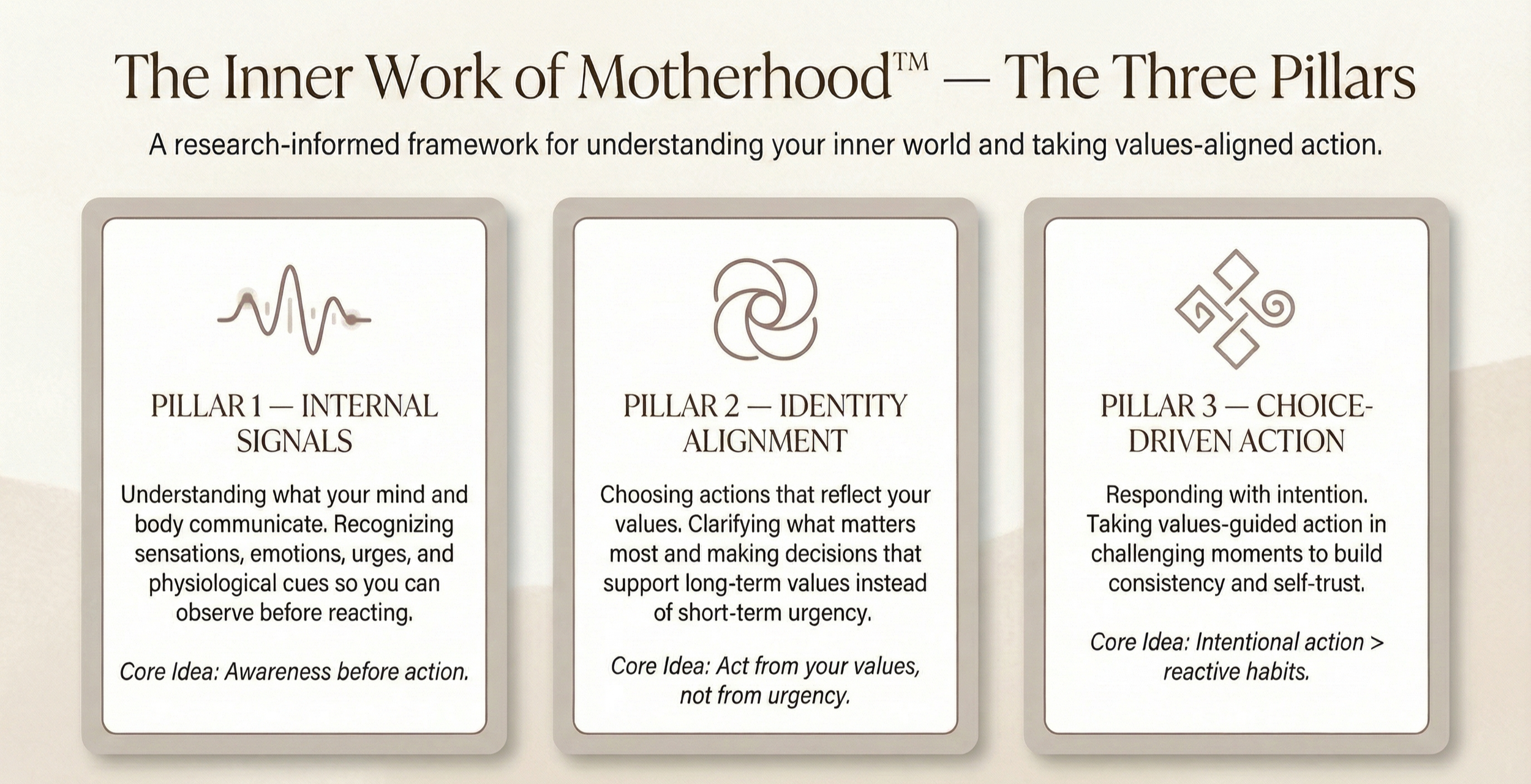
Motherhood becomes more manageable when you understand your inner world and can act from intention rather than reaction.
The Inner Work of Motherhood™ is grounded in behavioral science, Acceptance and Commitment Training, emotional regulation research, and lived maternal experience.
It’s the backbone of everything I teach.
This framework is organized into three core pillars.
THE THREE CORE PILLARS
1. Internal Signals
Your mind and body send signals throughout the day. Frustration, overstimulation, guilt, uncertainty, urgency, activation. Most mothers treat every signal as a crisis or a sign they are doing something wrong.
Internal Signals helps you distinguish:
• overload signals versus growth signals
• discomfort that needs a pause versus discomfort that builds capacity
• emotional activation versus actual danger
• guilt based in values versus guilt based in conditioning
This pillar gives you accurate understanding of your inner experience.
2. Identity Alignment
Motherhood reshapes your identity. The tension many mothers feel is identity recalibration, not failure.
Identity Alignment helps you:
• understand who you are becoming
• make choices that match your long term identity
• reduce second guessing and self doubt
• act with intention instead of urgency
• build self trust through aligned action
When your identity is clear, your decisions become simpler.
3. Choice Driven Action
Once you understand your signals and identity, you can respond with steadiness even in chaos.
Choice Driven Action teaches you how to:
• choose responses instead of react
• hold boundaries without guilt
• follow through with what matters
• course correct without shame
• regulate without suppressing your emotions
This is where your daily behavior begins to reflect the mother you want to be.
CORE TOOLs INSIDE THE INNER WORK MODEL
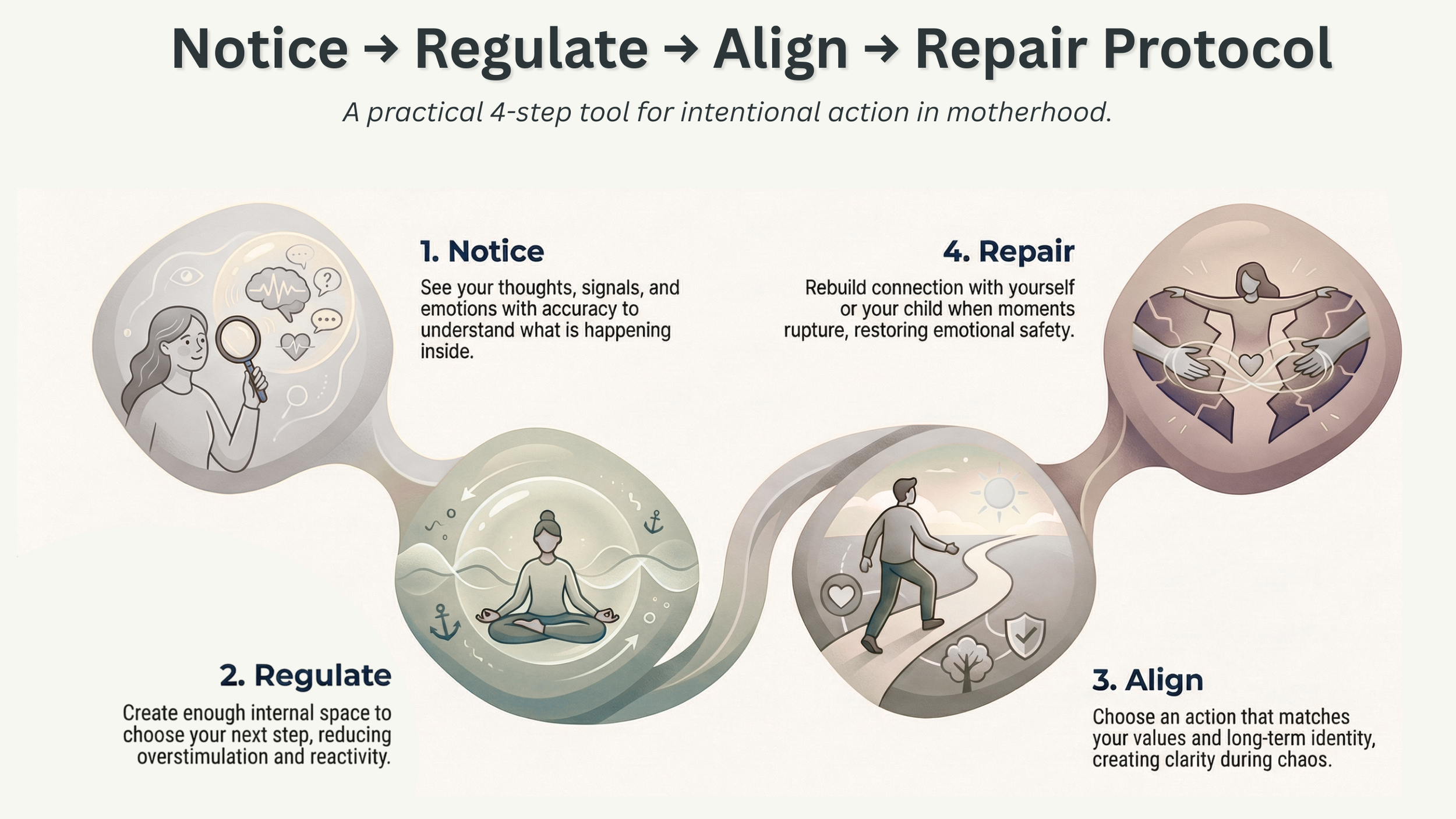
THE NOTICE → REGULATE → ALIGN → REPAIR PROTOCOL
This tool helps you move from internal activation to intentional action when things feel overwhelming. It pairs directly with the three pillars and gives you a simple way to apply the Inner Work in real daily moments.
Modern motherhood overloads your mind and nervous system.
Many mothers respond with survival patterns like people pleasing, avoidance, overfunctioning, or guilt-driven decisions.
The Inner Work of Motherhood™ helps you:
• understand your inner signals
• reduce emotional reactivity
• make intentional decisions
• access clarity during hard moments
• strengthen self trust
• create steadier days
This is not about perfection. It is about understanding yourself and responding with choice.
The Inner Work of Motherhood™ Framework is original intellectual property owned by Jessica Zielske. All rights reserved.

THE SCIENCE BEHIND THE INNER WORK OF MOTHERHOOD™
This framework is grounded in multiple evidence-based fields that help explain why modern motherhood feels overwhelming, and how intentional emotional skills reshape your wellbeing and your child’s. These research areas collectively support the principles of noticing internal signals, regulating your nervous system, aligning with values, and repairing with intention.
-
Psychological flexibility improves emotional steadiness, reduces stress, and supports healthier parenting behaviors.
Values-based action helps reduce guilt-driven decision-making and increases self-trust.
Experiential avoidance research shows that avoiding discomfort increases anxiety, reactivity, and burnout in parents.
ACT-based tools help parents respond more intentionally instead of reacting from urgency or overwhelm.
Foundational Research
Hayes, S. C., Strosahl, K. D., & Wilson, K. G. (1999). Acceptance and Commitment Therapy.
Kashdan, T. B., & Rottenberg, J. (2010). Psychological flexibility as a central process of mental health.
Coyne, L. W., & Wilson, K. G. (2004). ACT strategies in parenting and family interventions.
Byrne, S. P., et al. (2020). ACT for parent stress and emotional regulation.
-
TParents who understand observable behavior patterns respond with more clarity instead of interpreting everything as a personal failure.
Behavior science shows that small, consistent actions have a compounding effect on confidence and family stability.
Tools like prompting, shaping, and reinforcement help parents reduce chaos and support skill growth in children.
Behavior analysis helps parents understand triggers, patterns, and the function of their own emotional responses.
Foundational Research
Skinner, B. F. (1953). Science and Human Behavior.
Baer, D. M., Wolf, M. M., & Risley, T. R. (1968). The dimensions of applied behavior analysis.
Pears, K. C., & Fisher, P. A. (2005). Parenting interventions grounded in behavioral science.
Biglan, A. (2015). The Nurture Effect: How behavioral science can improve lives.
-
Chronic overstimulation and rapid shifting between roles increase physiological stress in mothers.
Regulation practices create space between “what you feel” and “what you do.”
Co-regulation research shows that parents’ ability to self-regulate directly influences children's emotional development.
Awareness of stress physiology (activation, shutdown, cues of safety) reduces reactive patterns.
Foundational Research
Porges, S. W. (2011). The Polyvagal Theory.
Siegel, D. J. (2012). Interpersonal neurobiology and parent-child regulation.
Feldman, R. (2015). Parent–child biobehavioral synchrony research.
Schore, A. N. (2012). Regulation theory and early relational health.
-
Children develop emotional regulation through repeated, reliable co-regulation with caregivers.
When parents understand their own signals, they respond more steadily to children’s developmental needs.
Research shows that parental stress impacts children’s stress physiology and behavior.
Responsive, attuned caregiving reduces long-term behavioral and relational challenges.
Foundational Research
Tronick, E. (2007). The Neurobehavioral and Social-Emotional Development of Infants and Children.
Sroufe, L. A. (2005). Attachment and family relationships.
Feldman, R. (2007). Biological and behavioral synchrony in parent-child interactions.
Cassidy, J. & Shaver, P. R. (2016). Handbook of Attachment.
-
Repair — not perfection — predicts long-term relationship strength between parents and children.
Research shows that quick, warm repair reduces shame and increases emotional safety.
Mothers who can repair internally after “messy moments” reduce guilt spirals and increase resilience.
Children who experience repair develop stronger emotion regulation and relational confidence.
Foundational Research
Tronick, E. & Gianino, A. (1986). The “still-face” and repair process.
Gottman, J. (1999). Repair attempts as predictors of relationship stability.
Fogel, A. (2009). Parent-infant interaction and the role of rupture and repair.
Schore, A. N. (2019). Repair in the development of secure attachment.
-
Research shows that avoiding discomfort increases anxiety, reduces self-trust, and reinforces reactive patterns.
Some discomfort signals harm or misalignment, while other discomfort signals growth — knowing the difference increases resilience.
Leaning into aligned discomfort builds identity strength and psychological flexibility.
Long-term wellbeing improves when mothers respond to internal signals instead of escaping them.
Foundational Research
Hayes, S. C. et al. (2012). Experiential avoidance and psychological suffering.
Panayiotou, G. (2017). The cost of avoidance in emotional disorders.
Barlow, D. H. (2004). Avoidance as a core process in anxiety and stress.
Linehan, M. (1993). Distress tolerance and behavioral patterns around discomfort.
These references represent only a small portion of the research base supporting psychological flexibility, emotional regulation, behavioral science, and developmental frameworks that inform The Inner Work of Motherhood™.
Want support using this framework in your real daily moments?
I teach mothers how to build emotional steadiness, respond with more choice, and move through the reality of raising young children with clarity and intention.
Listen to the latest episodes of Be Mom Your Way
Work With Me (Coming Soon)
Download the Inner Work Starter Pack