

The Inner Work of Motherhood™
Mothers take in more than most people realize.
You hear everything, feel everything, track everything, and manage the silent load that lives inside your mind and your body. It is a constant interaction between what your children need and what you are carrying internally.
The Inner Work of Motherhood™ Framework gives you a clear system for understanding that internal movement so you can move through your day with more steadiness, clarity, and choice.
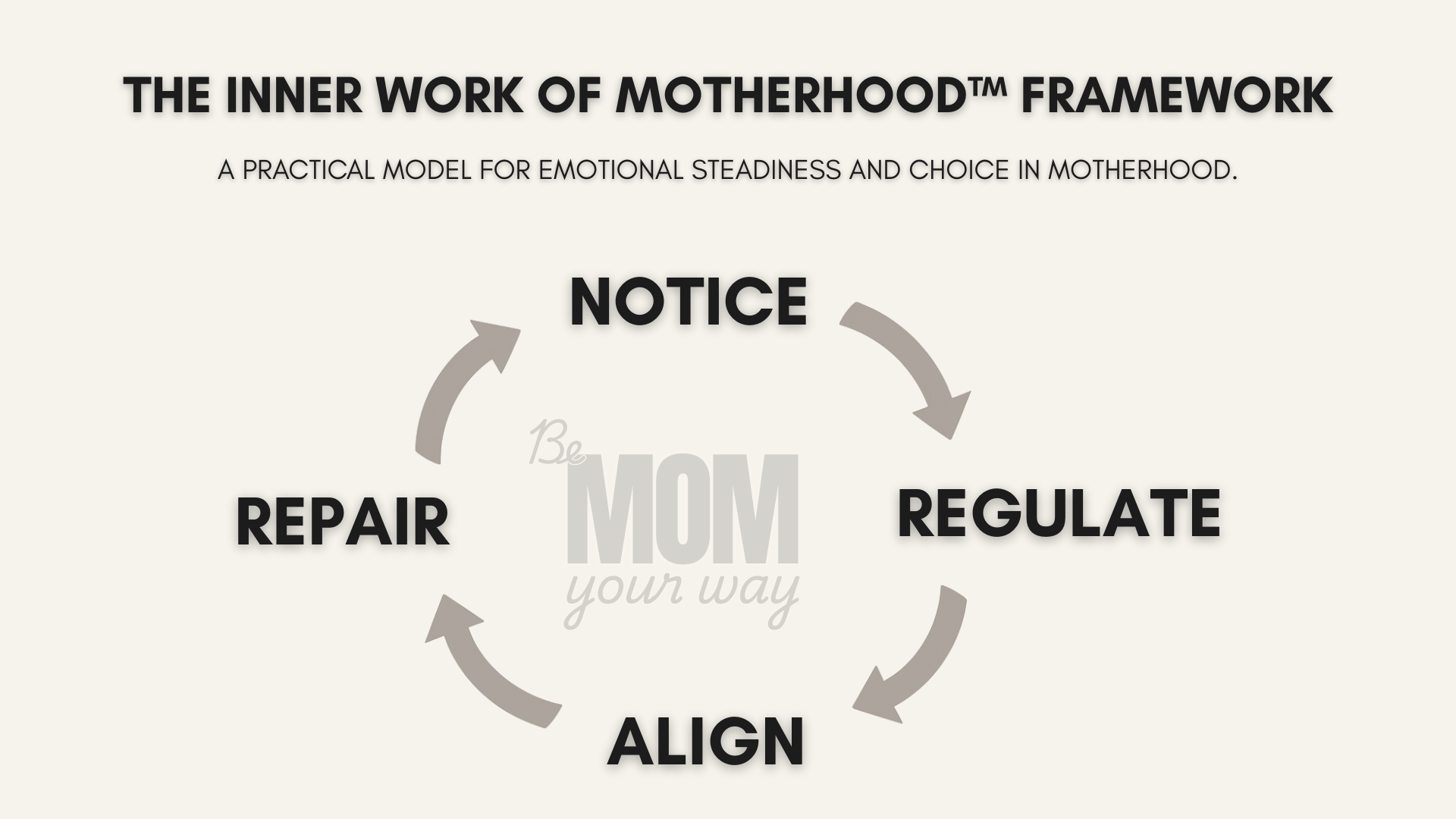
THE FOUR CORE STAGES
This framework is grounded in behavioral science, Acceptance and Commitment Training, emotional regulation research, and lived motherhood experience. It reflects the skills that support clarity, steadiness, and connection during demanding moments. Each stage is simple enough to use in daily life and strong enough to shift the patterns that shape how you show up.
It’s the backbone of everything I teach.
These stages guide the way you move through challenging moments from the inside out.
These four stages reflect what modern behavioral science, emotional regulation research, and developmental psychology consistently show about how humans change patterns and respond with more steadiness in demanding moments.
1. notice
Seeing what’s happening inside you with accuracy rather than judgment.
You can’t change what you can’t see. Awareness helps you recognize:
Your internal signals
Your patterns of overwhelm
What triggers tension, reactivity, or shutdown
What your body is communicating before your mind catches up
When you’re misaligned with your values
Awareness gives you language for your inner world so your reactions finally make sense.
2. Regulate
Supporting your nervous system so you can respond rather than react.
Regulation is not about being calm — it’s about having enough internal space to choose what comes next.
This stage helps you:
Reduce overstimulation
Recover from emotional intensity
Stabilize before making decisions
Interrupt reactive patterns
Re-engage with your kids with more steadiness
Regulation creates the gap between “what you feel” and “what you do.”


3. Align
Choosing responses that match your values, even when you're stretched thin.
Motherhood gives you dozens of micro-choices every day. Alignment helps you:
Respond based on the mom you want to be
Hold boundaries without guilt
Access clarity during chaos
Honor both your needs and your children’s needs
Live in a way that feels true to you
Alignment is where your inner world and outer behavior start matching again.
4. Repair
Making things better without shame — with yourself and your children.
Every mother ruptures. Repair teaches you how to:
Reconnect quickly and warmly
Restore emotional safety
Teach your children resilience
Repair internally when you feel off
Move forward without spiraling into “I messed up”
Repair is how relationships grow stronger — not weaker.


How the Stages Work Together
Motherhood is dynamic. These stages aren’t linear; they cycle.
Most days look like this:
Awareness → Regulation → Alignment → Repair → Awareness…
This cycle becomes the internal scaffolding that makes motherhood feel more manageable, more intentional, and more connected.
This is where practical science and real motherhood meet™.
The Inner Work of Motherhood™ Framework is original intellectual property owned by Jessica Zielske. All rights reserved.
SELECTED RESEARCH SUPPORTING THIS FRAMEWORK
This framework integrates behavioral science, emotional regulation research, ACT, and lived motherhood experience. It reflects the skills that support clarity, steadiness, and connection during demanding moments. Each stage is simple enough to use in daily life and strong enough to shift the patterns that shape how mothers show up.
-
Hayes, S. C., Strosahl, K. D., & Wilson, K. G. (2012). Acceptance and Commitment Therapy. Guilford Press.
Kashdan, T. B., & Rottenberg, J. (2010). Psychological flexibility as a fundamental aspect of health. Clinical Psychology Review, 30(7), 865–878.
-
Patterson, G. R. (1982). Coercive Family Process. Castalia.
Kazdin, A. E. (2005). Parent management training: Evidence, outcomes, and issues. Annual Review of Clinical Psychology, 1, 113–144.
-
Gross, J. J. (2015). Emotion regulation: Current status and future prospects. Psychological Inquiry, 26(1), 1–26.
Porges, S. W. (2011). The Polyvagal Theory. Norton.
McEwen, B. (1998). Protective and damaging effects of stress mediators. New England Journal of Medicine, 338, 171–179.
-
Feldman, R. (2012). Parent infant synchrony and the shaping of social brain development. Developmental Review, 32(1), 19–39.
Tronick, E. (2007). The Neurobehavioral and Social Emotional Development of Infants and Children. Norton.
-
Safran, J. D., & Muran, J. C. (2000). Negotiating the Therapeutic Alliance. Guilford.
Beebe, B., & Lachmann, F. (2013). The Origins of Attachment. Routledge.
These references represent only a small portion of the research base supporting psychological flexibility, emotional regulation, and developmental science in parent–child relationships.
I teach mothers how to build emotional steadiness, respond with more choice, and move through the reality of raising young children with more clarity and intention.
Want support using this framework in your real daily moments?
Listen to the latest episodes of Be Mom Your Way
Download the Inner Work Starter Pack
Work With Me (Coming Soon)